Convection steam oven
Wolf convection steam oven repair
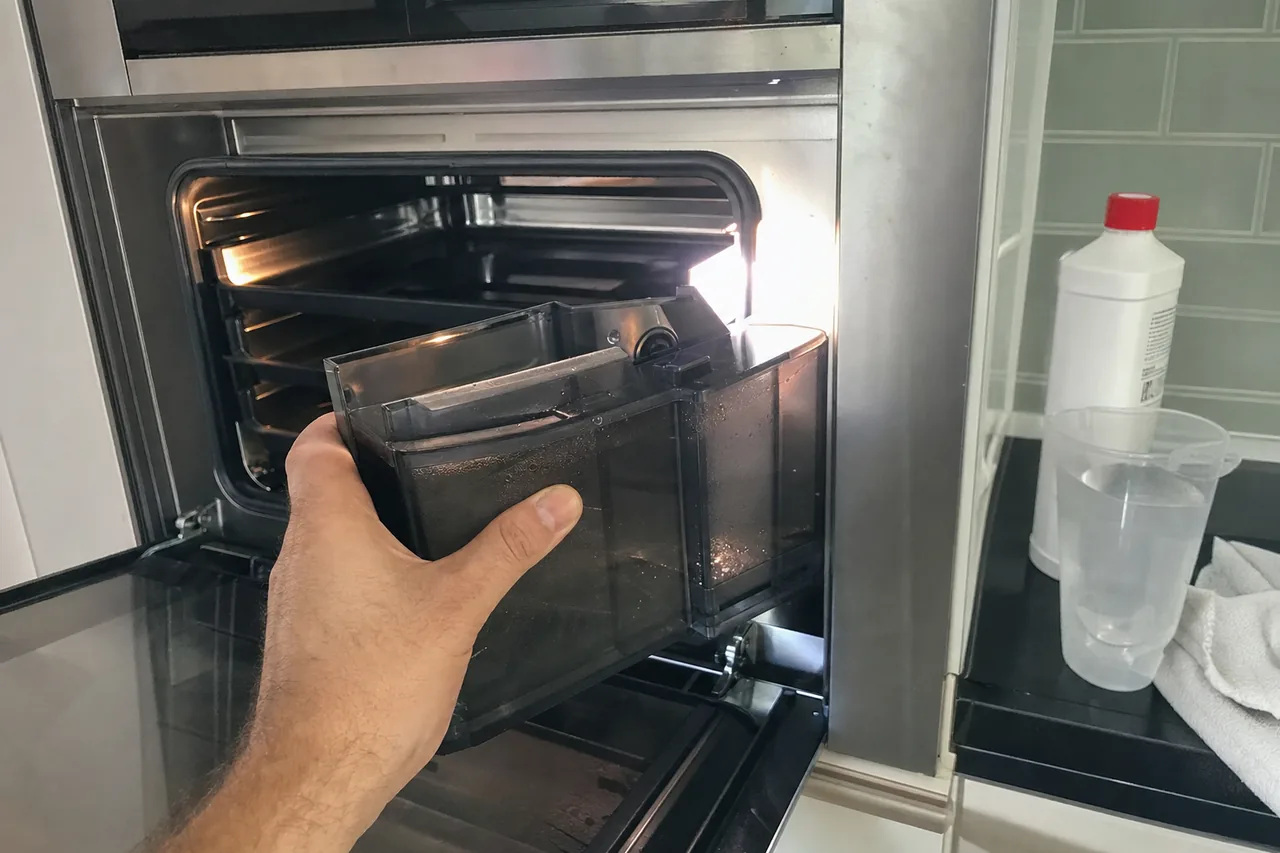
The most subsystem-heavy oven in the kitchen — a fill circuit, a generator, level sensing, a drain path and a door seal, any one of which presents as weak steam.
Symptoms
- Steam output is thin, or stops part way through a cycle
- The reservoir empties far faster than the cycle should use it
- Water is left standing in the cavity at the end of a cycle
- The oven reports a water fault with a full reservoir
- The cavity takes much longer than it used to to come up to temperature
- The door seal drips down the front, or the glass will not clear
- A fault clears on a power cycle and returns a few cycles later
Detail
A convection steam oven is the only appliance in the kitchen that has to move water, boil it, hold it at a controlled state, sense how much of it is left and then get rid of it again — all inside a sealed cavity that also runs as a conventional convection oven.
That is why it is the hardest cooking appliance to diagnose over the phone, and why nearly every complaint arrives as the same sentence: the steam is not what it was.
Five subsystems, one symptom
Weak or absent steam can come from any of five places, and they cost very different amounts to fix.
Supply. A reservoir that is not seated, a pump that primes slowly, or on a plumbed installation a shutoff that somebody closed during other work.
Fill. The valve or pump that meters water in. A seat that will not close gives a slow weep; one that will not open gives a cavity that never fills.
Generation. The element or generator that turns the water into steam, plus its thermal cutout. A tripped cutout is a symptom of something else, never the root cause.
Sensing. The probes or floats that report level and temperature. Sensing faults are the great impostors: they produce confident, wrong error states.
Discharge. The drain path, and the door seal that decides whether steam leaves through the drain or down the front of your cabinetry.
The order we check in, and why
We work outward from what is free to check toward what costs money to replace, because that order is the one that protects you from paying for a part that was never the fault.
First, the installation and the supply: is the unit seated, is it level, has anything been closed off, and does it have the circuit it expects. Second, the fill behaviour on a live cycle — we want to watch it take water rather than infer it. Third, sensing, because a water fault reported with a full reservoir is a sensing story until proven otherwise. Fourth, the generator and its cutout. Fifth, the drain and the seal. The control board is last, and it is last for a reason: most faults blamed on boards turn out to be a sensor telling the board something untrue.
Local water is worth one line here. JEA’s published hardness for 32082 is 346 ppm, so anything that boils water in this ZIP leaves more mineral behind per cycle than the same appliance would inland. In practice that means we inspect the generator surface, the fill seat and the level probe on every visit, whatever the reported symptom, and it means descaling on a set interval rather than waiting for a prompt is the cheapest thing an owner can do for one of these.
Getting the unit out
Steam ovens are built in, usually in a tall cabinet and often stacked with a wall oven. Nothing about servicing one is a countertop job.
The opening rarely matches the spec sheet in a kitchen that has been renovated around it, the trim has to come off before the chassis will move, and the unit is heavier than it looks — it is a two-person lift out of a cabinet, onto protection, not onto your floor. We check the clearances and the circuit before we quote anything that involves pulling it, because a job that needs the cabinetry eased is a different job from one that does not.
Parts, and why we ask for the serial number
Components on these vary within the same model designation. The serial number is what tells the supplier which revision your unit takes, and fitting the wrong revision of a valve or a sensor wastes a visit and a restocking fee. We read the rating plate before we order, quote the supplier’s lead time rather than an optimistic one, and fit genuine parts only.
Repair, replace, or neither
Built-in equipment is worth repairing far longer than freestanding equipment, because the replacement cost is never just the appliance — it is the cabinetry, the trim and the fitting. But there is a line, and a generator that has been run hard for years is usually where it sits. We will tell you which side of it your unit is on before you spend anything.
Where a fault points at a sealed assembly or a design issue rather than a serviceable part, we say so and tell you to go to the manufacturer. That is a better answer than an expensive guess.
What a visit looks like
Flat diagnostic fee, credited toward the repair. Written estimate before any part is ordered, genuine parts, and the check order above written down so you can see what was ruled out and what was not.
Where this comes up
- Ponte Vedra Beach32082
- Marsh Landing32082
- Sawgrass Players Club32082
- Palm Valley32082
The rest of the work
- Wolf dual fuel range repairDual fuel range
- Wolf gas range repairGas range
- Wolf rangetop and cooktop repairRangetop or cooktop
- Wolf built-in wall oven repairBuilt-in wall oven
- Wolf hood, blower and downdraft repairVentilation hood
- Wolf built-in outdoor grill repairBuilt-in outdoor grill
Booking
Flat $80 diagnostic, credited toward the repair when you go ahead with it. You get a written estimate before any part is ordered or any labour is billed. 90 days on labour, 365 days on parts, genuine OEM parts only.
+1 (904) 201-3304After a convection steam oven call
4.6
out of 5, across 67 customer reviews. Each one below is a single visit, written by the person who paid for it.
Steam kept getting past the upper door seal and staining the cabinet face over it. He fitted a fresh gasket, reset how far the catch pulls in, and cleaned the stain off himself. Nothing has marked since.
Barnaby H.
The unit heated but never made proper steam. He showed me the scale built up on the generator wall, descaled it twice and explained why our water leaves that much behind. It steams like new again.
Gideon F.
Ours threw a sensor code every time it went into combination mode. He measured the probe resistance cold and again hot, matched both against the curve and replaced it. The code has not come back.
Leopold W.
The book
What does this repair cost?
$80
Flat $80 diagnostic covering the visit and the full diagnostic sequence, credited toward the repair once you approve the work. Everything under it is a band, not a quote. The figure that counts is written down after the diagnosis, and it covers the part, the labour to fit it, and the warranty — 90 days on labour, 365 days on parts, genuine OEM parts only.
| What was wrong | Typical finished repair |
|---|---|
| Diagnostic visit on its own | $80, credited |
| Oven thermostat or temperature sensor | $170–$530 |
| Door hinge, glass or seal | $200–$660 |
| Convection fan or motor | $260–$730 |
Those are the bands this page's faults land in; the rest of the book is on the rates page. The top of them is $730, and nothing at all — at that figure or well under it — is billed without a written estimate you have agreed to first.
Asked on the phone
What else do people ask?
- Why is the oven running cold or taking an age to preheat?
- Either the sensor is reading wrong or the element is not making the heat it claims. A probe on the rack at three settings separates the two inside a quarter of an hour. A sensor or thermostat replacement falls in $170–$530; a calibration trim on a sound oven is part of the visit.
- A blower has started to growl. Can it wait?
- On this coast that growl is usually salt in the bearings, and a bearing caught while it still turns is a far smaller job than a seized motor and a scorched winding. Fan and motor work sits at $260–$730. Bring it forward rather than waiting for it to stop.
- The door no longer sits flush. Does that matter?
- It does. A door a few millimetres proud loses heat past the seal, so the cavity chases a temperature it never reaches and the element runs far longer than it should. Hinges, glass and seals are one band, $200–$660, and correcting it early saves the element behind it.
- What does a visit cost?
- Flat $80 diagnostic, credited toward the repair when you go ahead with it. You get a written estimate before any part is ordered or any labour is billed. There is no separate travel charge inside the 40-mile radius.