maintenance
Maintenance that actually prevents a Wolf service call
Very few cooking appliances fail suddenly. They fail slowly, in public, and the owner adjusts around it until the day it stops. This is what to watch.
Note
Almost nothing in a kitchen fails without warning. The blower got louder over a winter. The burner needed two goes to catch, then three. The oven took a little longer to come up, and the cook adjusted rather than complained.
By the time we are called, the cheap version of the repair has usually passed. This is the short list of what genuinely postpones that, in rough order of how much it is worth.
Hood baffles and filters
The single highest-value job in the room, and the one most often skipped.
Grease that gets past a loaded baffle lands on the blower wheel. It does not land evenly, so the wheel goes out of balance, and an out-of-balance wheel loads a bearing that was never specified for a side load. That is the whole mechanism behind the rumble-then-whine-then-nothing sequence we are called out for.
Baffles come out and go back one way round. Degrease them hot rather than scrubbing them cold, let them drain properly, and put them back dry — a wet baffle sits against a housing and holds moisture against metal, which on this coast is the last thing you want.
Burner caps, ports and electrodes
After a boil-over, lift the cap and the head off once everything is cold, and clean and dry the seat under them. A cap that sits on sugar or crusted starch does not sit flat, and a burner that does not sit flat lights unevenly and sounds wrong.
Clear a blocked port with something that will not break off inside it. A wooden toothpick snapping in a port turns a five-minute job into a callout. Keep the spark electrode dry and free of spill: it is a ceramic insulator with a wire through it, and it will happily send its spark to the nearest wet crumb instead of across the gap.
Oven doors and seals
Run a hand around the gasket occasionally for hard, flattened or missing sections. A door that has stopped sealing costs heat at the top of the cavity first, so the complaint arrives as uneven baking rather than as a door problem.
Do not lean on an open oven door and do not use it as a shelf for a heavy roasting tin. Hinges on a built-in door carry a lot of weight through a small mechanism, and a sagging door is both a seal problem and an expensive part.
Self-clean is a stress event
A self-clean cycle runs the cavity hotter than any cooking will, for hours. That is exactly the condition under which a tired element, a thermal cutout or an ageing board finally gives up.
None of that is an argument against using it. It is an argument for running it well ahead of the day you need the oven, rather than the night before a holiday. The self-clean cycle does not cause those failures so much as find them.
Steam ovens between uses
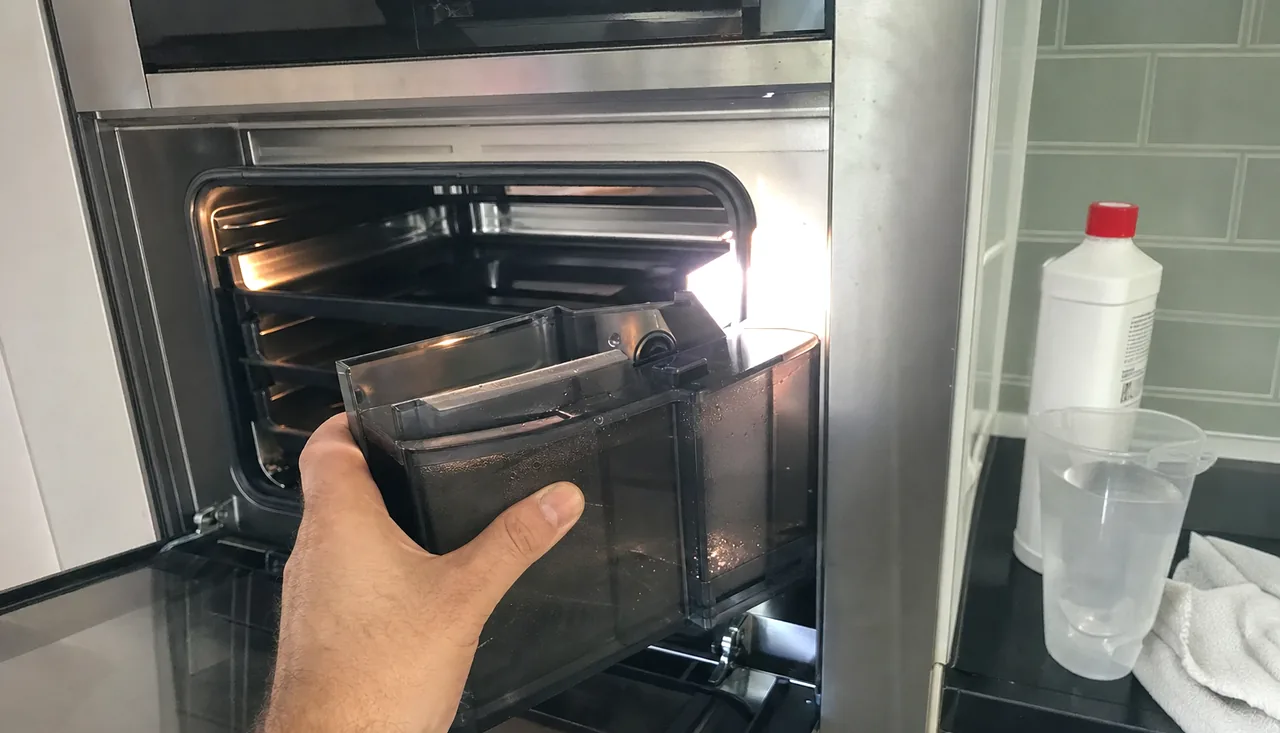
Empty the reservoir instead of leaving it standing, wipe the cavity floor while it is still warm, and leave the door ajar until the inside is dry. Standing water in a warm sealed cavity is where the smell people mistake for a fault comes from.
Outdoor equipment
Run the burners for a few minutes after cooking, then close the lid and cover it once cool. The usual failures out here are corrosion at the electrode brackets, the valve stems and the burner tubes, and a stiff valve stem is a warning rather than an inconvenience. Forcing a gritty stem is how stems shear.
After a power event
When the supply has been in and out, look at the kitchen deliberately: clocks that reset, a fan that no longer changes speed, a control that responds late. Faults from supply disturbances do not always land the same afternoon, and a symptom that started the week the power was unstable is a useful thing to be able to tell us.
Two minutes that save a visit
Photograph the rating plate — model and serial — and keep it on your phone. It is behind the door frame or under the control panel on most units, and it is the difference between us bringing the right revision of a part and bringing a lesson.
What is not worth doing yourself
Anything inside the gas train, anything behind a panel that needs the appliance pulled, and running a unit we have written a fault up on. The first two are safety; the third is how a repairable fault becomes a replacement.
After a call like this
4.6
out of 5, across 67 customer reviews. Each one below is a single visit, written by the person who paid for it.
The remote hood control had stopped talking to the motor up in the attic. He checked the wiring run, found a connector corroded green up there, remade it and secured the cable clear of the roof line.
Rosalind S.
It pulled well enough but rattled like a tin roof in a squall. He found the damper flap worn at its pivot, fitted a new one and shimmed the liner where it meets the wall. Quiet again, and the old parts went with him.
Zephyrine L.
Ours vibrated hard whenever the wind came off the ocean. He fitted a proper backdraft damper and isolation mounts, which has settled it. I would rather that had been done on the first visit than the second.
Bartholomea P.
The equipment
- Wolf gas range repairGas range
- Wolf built-in wall oven repairBuilt-in wall oven
- Wolf convection steam oven repairConvection steam oven
- Wolf hood, blower and downdraft repairVentilation hood
Where it turns up
- Ponte Vedra Beach32082
- Sawgrass Players Club32082
- Palm Valley32082
Notes alongside
- Wolf oven thermostat replacement: rule out these settings firstparts
- When a Wolf oven is not heatingsymptom
- When a Wolf burner clicks and never catchessymptom
- Why the old cabinet opening decides a Wolf jobinstall
- Why we quote a Wolf parts lead time, not a promiseparts
- Why coastal Wolf hood blowers fail firstcoast
- What summer storms do to a Wolf control boardcoast
Stuck on it
If the symptom in this note matches what your appliance is doing, the next step is a diagnostic on site rather than another part ordered on a guess.
The book
What does this repair cost?
$80
Flat $80 diagnostic covering the visit and the full diagnostic sequence, credited toward the repair once you approve the work. Everything under it is a band, not a quote. The figure that counts is written down after the diagnosis, and it covers the part, the labour to fit it, and the warranty — 90 days on labour, 365 days on parts, genuine OEM parts only.
| What was wrong | Typical finished repair |
|---|---|
| Diagnostic visit on its own | $80, credited |
| Igniter or spark module replacement | $190–$540 |
| Burner valve or orifice service | $220–$710 |
| Oven thermostat or temperature sensor | $170–$530 |
| Convection fan or motor | $260–$730 |
Those are the bands this page's faults land in; the rest of the book is on the rates page. The top of them is $730, and nothing at all — at that figure or well under it — is billed without a written estimate you have agreed to first.
Asked on the phone
What else do people ask?
- What does a visit cost?
- Flat $80 diagnostic, credited toward the repair when you go ahead with it. You get a written estimate before any part is ordered or any labour is billed. There is no separate travel charge inside the 40-mile radius.
- Are the parts genuine?
- Genuine OEM parts only. We quote the supplier's lead time rather than a promise, and if a part is on back order you hear that before you commit to the repair.
- Is this an independent shop, or an authorized service centre?
- Independent, and not an authorized service centre. No manufacturer appoints, vets, trains or supervises Dunecrest Cooking Service, and nothing here should be read as though one did. We name Wolf only to say which appliances we work on.