Built-in wall oven
Wolf built-in wall oven repair
Single and double electric wall ovens, including convection faults, calibration drift and the hinge and gasket problems that come with a heavy door.
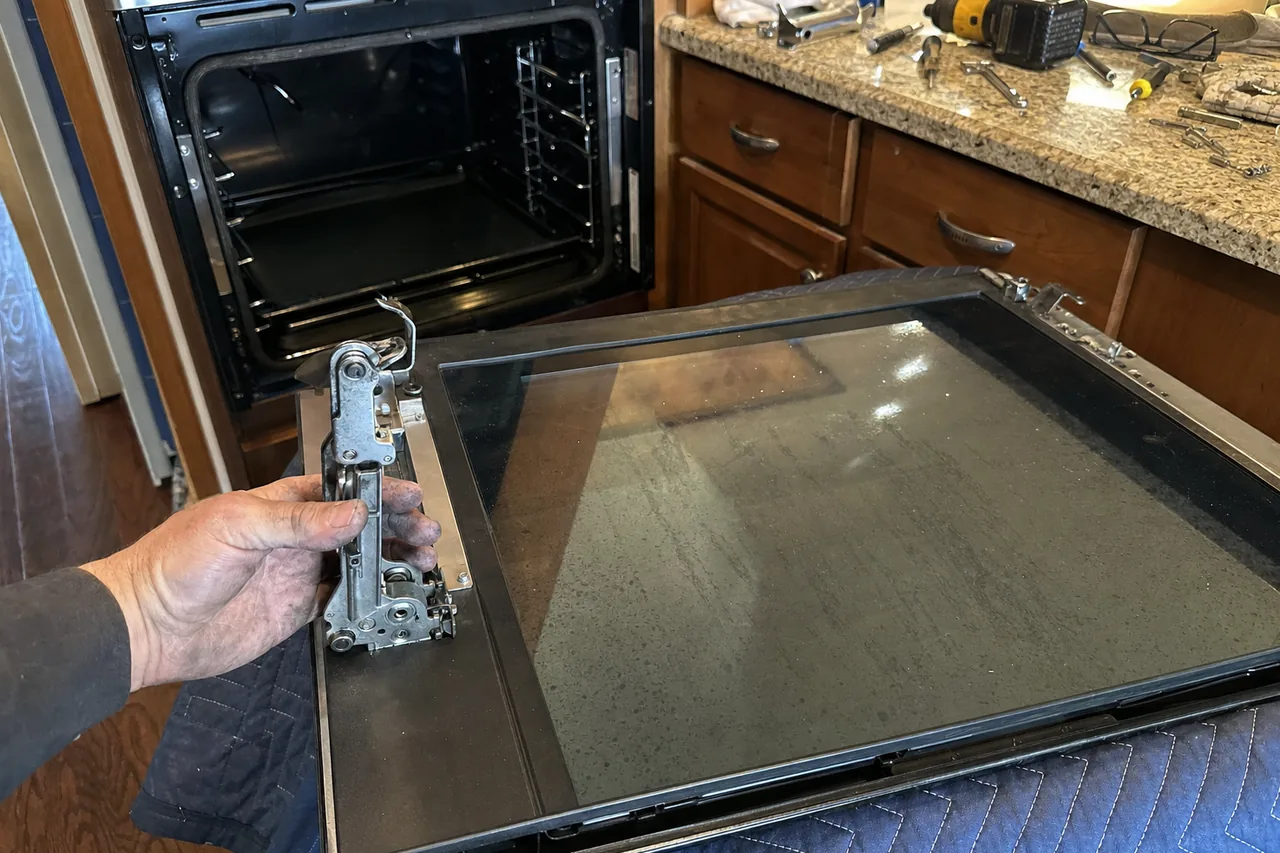
Symptoms
- The oven is not heating at all, though the panel still lights
- The oven runs hot or cold against a known oven thermometer
- Preheat takes far longer than it used to
- Convection bakes unevenly front to back or shelf to shelf
- The fan is noisy, rattles at speed, or has stopped turning
- The door will not close square, or sags at one corner
- The control panel is dark, frozen or resets itself
- The oven trips the breaker part way through a self-clean
Detail
A built-in wall oven is the hardest appliance in the kitchen to get at and the easiest to misdiagnose, because almost every complaint arrives as the same sentence: it is not cooking right.
Calibration versus a real fault
An oven that is twenty degrees off is not necessarily broken. Ovens are calibrated against a sensor, sensors drift, and a drifted sensor is a five-minute adjustment. An oven that is twenty degrees off at one setting and sixty degrees off at another is a different animal — that is a nonlinear error, and nonlinear errors come from the sensor element itself, from a harness connection that has picked up resistance, or from an element that is only partly conducting.
So the first thing we do is not adjust anything. We log the cavity temperature through a full cycle at two setpoints and see what shape the error is. Five minutes of measurement saves an afternoon of parts swapping.
Convection
True convection puts a heating element in the fan ring so the air arriving at the food is already at temperature. When that ring element fails, the fan still turns, the oven still reaches setpoint on the main elements, and the customer’s description is that convection stopped making a difference. Nothing looks broken. It is a resistance check.
A fan that has become noisy is usually a bearing, and bearings in an oven fan fail for a specific reason: they run hot and they have to survive the temperature swing of every self-clean cycle. If the noise appeared shortly after a clean cycle, that is not a coincidence.
Doors, hinges and seals
Wall oven doors are heavy, and the hinge takes the whole load through a small spring assembly. A door that sags at one corner, will not sit square, or suddenly slams the last inch has a hinge going. Doors are also the most common source of the complaint that everything browns on one side: heat leaving at a gap does not just waste energy, it sets up a draught across the cavity.
Gaskets go hard rather than tear. If you can slide a sheet of paper out from between the door and the frame with no drag at one point and real drag at another, the seal is done.
Controls, and why they die here
Oven control boards are the part we replace most, and St. Johns County gives them a hard life. Storms run through most summer afternoons, and every one of them brings the kind of brief supply disturbance that a control board is expected to shrug off and eventually does not. A board that dies at 3pm on an August afternoon usually died for a reason that had nothing to do with cooking.
Self-clean is the other board killer, for a simpler reason: it is the hottest thing the appliance ever does, and the components nearest the cavity age fastest during it. We are not going to tell you never to run it. We will tell you that running it the night before a holiday, with no time to react, is a gamble.
Double ovens
On a double stack, the two cavities usually share a control and sometimes share a cooling fan. That matters, because a fault in the lower cavity can present as a symptom in the upper one. When a customer tells us the top oven behaves strangely only when the bottom one is running, that is a useful sentence, not a confused one.
What a visit looks like
Flat diagnostic fee, credited toward the repair. Written estimate before parts are ordered, genuine OEM parts, and an honest answer about whether an older cabinet opening will accept the replacement if the oven turns out to be beyond economic repair.
Field notes
- Wolf oven thermostat replacement: rule out these settings firstparts
- When a Wolf oven is not heatingsymptom
- Maintenance that actually prevents a Wolf service callmaintenance
- Why the old cabinet opening decides a Wolf jobinstall
- Why we quote a Wolf parts lead time, not a promiseparts
- What summer storms do to a Wolf control boardcoast
Where this comes up
- Ponte Vedra Beach32082
- Sawgrass Players Club32082
The rest of the work
- Wolf dual fuel range repairDual fuel range
- Wolf gas range repairGas range
- Wolf rangetop and cooktop repairRangetop or cooktop
- Wolf convection steam oven repairConvection steam oven
- Wolf hood, blower and downdraft repairVentilation hood
- Wolf built-in outdoor grill repairBuilt-in outdoor grill
Booking
Flat $80 diagnostic, credited toward the repair when you go ahead with it. You get a written estimate before any part is ordered or any labour is billed. 90 days on labour, 365 days on parts, genuine OEM parts only.
+1 (904) 201-3304After a built-in wall oven call
4.6
out of 5, across 67 customer reviews. Each one below is a single visit, written by the person who paid for it.
The hinges had let the door drop and heat was escaping across the top edge. He replaced both, adjusted the spring tension and rechecked the seal with a strip of paper the whole way round the frame.
Marguerita S.
Our lower cavity browned everything down one side. He shimmed the unit square in a cabinet it had been fitted twisted into, and put in a tired element. Two visits, because the part had to come in.
Philomena C.
Our double wall oven quit heating in the top cavity the week before a party. He measured the element cold, found it open and had one on the van. He cleaned the vent slots while he was in there.
Alessandra V.
The book
What does this repair cost?
$80
Flat $80 diagnostic covering the visit and the full diagnostic sequence, credited toward the repair once you approve the work. Everything under it is a band, not a quote. The figure that counts is written down after the diagnosis, and it covers the part, the labour to fit it, and the warranty — 90 days on labour, 365 days on parts, genuine OEM parts only.
| What was wrong | Typical finished repair |
|---|---|
| Diagnostic visit on its own | $80, credited |
| Oven thermostat or temperature sensor | $170–$530 |
| Convection fan or motor | $260–$730 |
| Control board or touch panel | $420–$1,070 |
| Door hinge, glass or seal | $200–$660 |
Those are the bands this page's faults land in; the rest of the book is on the rates page. The top of them is $1,070, and nothing at all — at that figure or well under it — is billed without a written estimate you have agreed to first.
Asked on the phone
What else do people ask?
- Why is the oven running cold or taking an age to preheat?
- Either the sensor is reading wrong or the element is not making the heat it claims. A probe on the rack at three settings separates the two inside a quarter of an hour. A sensor or thermostat replacement falls in $170–$530; a calibration trim on a sound oven is part of the visit.
- A blower has started to growl. Can it wait?
- On this coast that growl is usually salt in the bearings, and a bearing caught while it still turns is a far smaller job than a seized motor and a scorched winding. Fan and motor work sits at $260–$730. Bring it forward rather than waiting for it to stop.
- The panel went dark during a storm. Is the whole board gone?
- Not necessarily. Surges here rarely kill a board outright; they take a relay, a supply section or a ribbon connection, and those are separable faults. The supply gets measured before anyone orders anything. A board or touch panel replacement is the top band on the table, $420–$1,070.
- What does a visit cost?
- Flat $80 diagnostic, credited toward the repair when you go ahead with it. You get a written estimate before any part is ordered or any labour is billed. There is no separate travel charge inside the 40-mile radius.