symptom
When a Wolf burner clicks and never catches
The spark is happening, so the electrical side is broadly alive. That single fact rules out most of the expensive answers immediately.
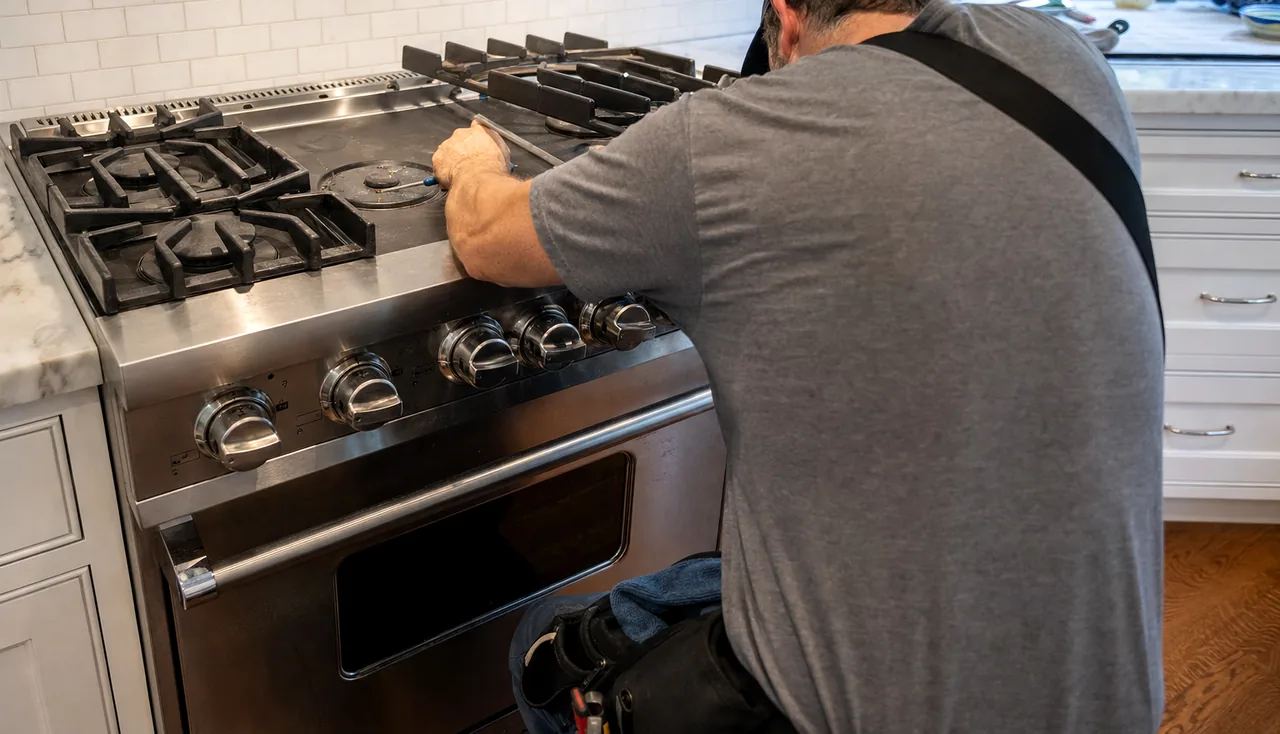
Note
Clicking is good news. It means the switch closed, the module fired, and there is a spark at an electrode somewhere. The fault is between that spark and the gas, and that is a short list.
Check the obvious first, in this order
Is the burner cap seated? A cap sitting even slightly proud of its seat, or rotated off its locating pin, puts the flame ports in the wrong place relative to the electrode. After a wash-up this is the most common cause of all, and it takes five seconds to rule out.
Is the cap dry? A cap or head washed and put back damp will spark enthusiastically and light nothing until it dries. If the burner started misbehaving the same evening the caps were cleaned, that is the answer.
Are the ports clear? Boil-over residue closes ports from the outside in. The port nearest the electrode is the one that matters — spark in one place and fuel in another lights nothing. A pin, gently, is the right tool; a drill bit is not.
Is the electrode clean and intact? Look at the ceramic. A crack in the insulator lets the spark track down to the nearest grounded metal instead of jumping the gap. You will still hear clicking. It just is not clicking anywhere useful.
Two things people assume and should not
The valve is almost never the problem. Valves are mechanical, they fail rarely, and they usually fail by being stiff rather than by not passing gas. If a technician’s first answer to a no-light is a valve, ask what test led there.
The spark module is also rarely the problem when the burner clicks, because a clicking burner proves the module works. The module becomes a suspect when burners spark continuously with every knob off, which is a stuck or wet switch loading the module, or when nothing sparks at all.
What the coast adds
Two things, both electrical rather than gaseous.
Salt film builds on the electrode and its insulator and survives an ordinary wipe. It does not stop the spark, but it gives the spark an easier path to ground than the one across the gap, which is functionally the same as a cracked insulator.
Humidity gets into the module housing and the harness terminals. Terminals tarnish, resistance climbs, and the spark energy at the electrode drops below what it needs to be. The classic presentation is a burner that lights fine in the afternoon and fights you first thing in the morning, when everything metal in the house is carrying dew.
Houses within sight of the dune line go through electrode assemblies faster than houses a few miles back. That is not a quality problem with the appliance.
Outdoors, add two more
On a built-in grill, an electrode bracket that has corroded has usually also moved, and a spark gap that is out by a millimetre or two will not light. And the crossover channel that carries flame from one burner to the next is exactly the kind of narrow passage that closes up outdoors — which is why an exposed grill often lights burner by burner but will not carry across.
When to stop and call
If the cap is seated and dry, the ports are clear, the ceramic is sound and it still will not light, the next steps involve gas pressure at the regulator and the flame-sense circuit. Those need a manometer and a meter, and they are not worth improvising around a live gas connection.
If you smell gas at any point, stop, shut the supply off, and do not use the appliance.
After a call like this
4.6
out of 5, across 67 customer reviews. Each one below is a single visit, written by the person who paid for it.
Our range would not light at all after a power cut. He found a failed transformer down in the base, replaced it and checked the rest of the low-voltage side. Good work, though the visit ran late.
Josefina B.
The oven under our range would light and then drop out after roughly ten minutes, every single time. He put a meter on the flame sensor, let me watch the reading fall away, and changed it. Steady since.
Amadeus F.
The simmer was far too fierce to hold a sauce. He adjusted the low-flame screw on each valve to the right setting for our gas and showed me what the flame ought to look like when it is set properly.
Winslow X.
The equipment
- Wolf gas range repairGas range
- Wolf rangetop and cooktop repairRangetop or cooktop
- Wolf built-in outdoor grill repairBuilt-in outdoor grill
Where it turns up
- Ponte Vedra Beach32082
- The Plantation32082
Notes alongside
- Wolf cooktop or rangetop: which one fits your kitcheninstall
- When a Wolf oven is not heatingsymptom
- Maintenance that actually prevents a Wolf service callmaintenance
- Why the old cabinet opening decides a Wolf jobinstall
- Why we quote a Wolf parts lead time, not a promiseparts
- Why coastal Wolf hood blowers fail firstcoast
- What summer storms do to a Wolf control boardcoast
Stuck on it
If the symptom in this note matches what your appliance is doing, the next step is a diagnostic on site rather than another part ordered on a guess.
The book
What does this repair cost?
$80
Flat $80 diagnostic covering the visit and the full diagnostic sequence, credited toward the repair once you approve the work. Everything under it is a band, not a quote. The figure that counts is written down after the diagnosis, and it covers the part, the labour to fit it, and the warranty — 90 days on labour, 365 days on parts, genuine OEM parts only.
| What was wrong | Typical finished repair |
|---|---|
| Diagnostic visit on its own | $80, credited |
| Igniter or spark module replacement | $190–$540 |
| Burner valve or orifice service | $220–$710 |
Those are the bands this page's faults land in; the rest of the book is on the rates page. The top of them is $710, and nothing at all — at that figure or well under it — is billed without a written estimate you have agreed to first.
Asked on the phone
What else do people ask?
- What moves a quote up or down inside a band?
- Three things: which part it turns out to be, whether the appliance has to come out of its opening to reach it, and whether that part is on the shelf or on back order. Access is the one that surprises people — a built-in fitted tight into old cabinetry adds work before any part is touched.
- Why does a burner click and click without catching?
- Almost always the spark electrode or the module driving it: a cracked ceramic, a fouled tip, or a boil-over that has bridged the gap. A cap sitting a degree out of its seat will do it too, and that costs nothing to correct. Replacing the igniter or the spark module runs $190–$540.
- What does a visit cost?
- Flat $80 diagnostic, credited toward the repair when you go ahead with it. You get a written estimate before any part is ordered or any labour is billed. There is no separate travel charge inside the 40-mile radius.
- Are the parts genuine?
- Genuine OEM parts only. We quote the supplier's lead time rather than a promise, and if a part is on back order you hear that before you commit to the repair.